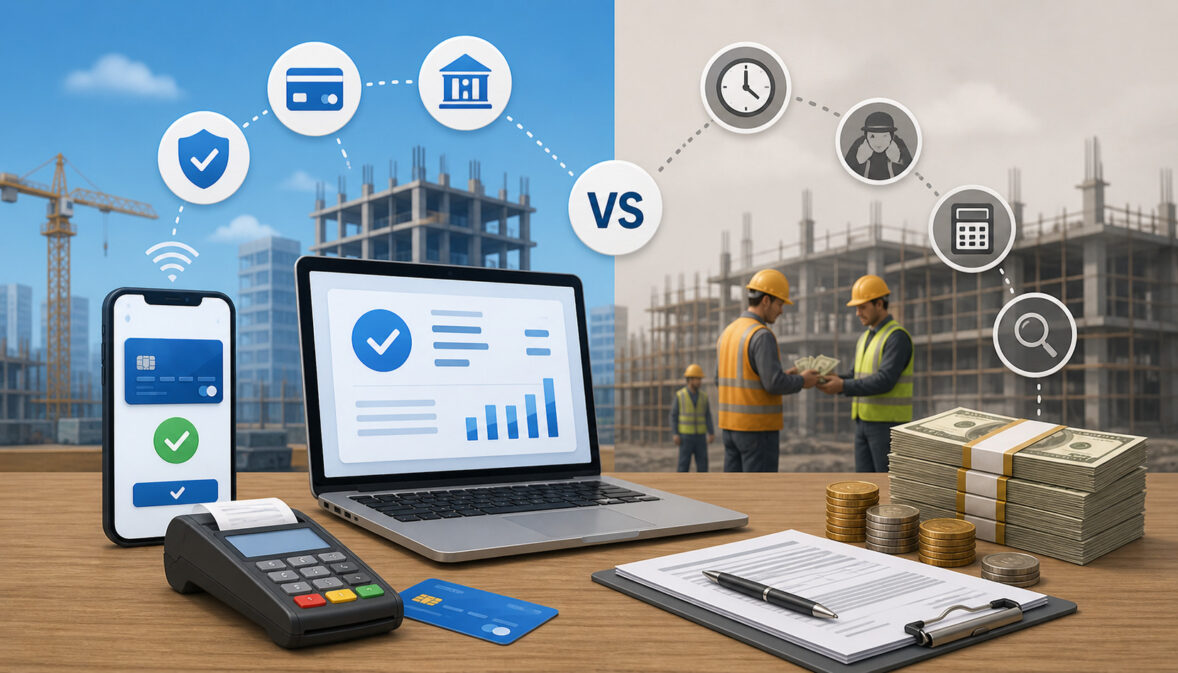
Payment methods matter in construction because money moves at different points in a project: deposits, progress payments, change orders, final invoices, subcontractor payments, emergency repairs, and warranty work.
A contractor may collect a small service fee on-site one day and manage a multi-stage billing schedule the next. The way those payments are accepted affects cash flow, client experience, documentation, security, and the amount of administrative work required after the job is done.
For contractors, builders, remodelers, subcontractors, and project managers, the question is not always whether digital payments or cash payments are “better.” The better question is which method fits the job, the client, the payment amount, and the level of recordkeeping required.
Digital Payments vs Cash Payments in Construction is an important decision because payment habits are changing. Many clients expect invoices they can pay online, payment links they can open from a phone, and receipts they can save automatically.
At the same time, cash payments in construction industry settings still appear in small repair work, quick service calls, tips, small deposits, and local jobs where both parties are comfortable with immediate payment.
The challenge is balance. Contractors need convenient contractor payment methods without creating unnecessary risk. They need fast collection without messy records. They need payment security without making payment too complicated for customers.
They also need systems that support construction billing, cash flow management, and accurate financial reporting.
A practical construction payment methods comparison should look at both sides: how digital payment systems for construction improve speed and documentation, and where cash still has limited but useful applications when handled responsibly.
Understanding Construction Payment Methods
Construction businesses use several payment methods, and each one has a different impact on cash flow, records, client convenience, and risk. The most common contractor payment methods include cash, checks, ACH transfers, credit cards, debit cards, mobile payments, payment links, and online invoices.
Some contractors also accept digital wallets, recurring billing, or bank-to-bank transfers depending on their setup and customer base.
Cash is the simplest method on the surface. A customer pays, the contractor receives funds immediately, and no card processing fee applies. However, cash requires disciplined receipts, deposit logs, secure handling, and careful bookkeeping.
Without those controls, it becomes harder to prove what was paid, when it was paid, and what invoice or job the payment belonged to.
Checks remain common in construction, especially for larger invoices, commercial clients, property managers, and older customers. They provide a paper trail, but they can create delays. A check may be mailed late, deposited days after receipt, returned for insufficient funds, or require manual tracking.
ACH payments move money from one bank account to another electronically. They are often useful for larger invoices, recurring payments, deposits, and progress billing because they can be more cost-effective than card payments.
Contractors comparing ACH payments with cards should consider transaction size, settlement timing, return risk, and customer preference. For more detail on this option, see this guide to ACH payments for construction businesses.
Card payments are convenient for customers and can help contractors collect faster. Credit cards and debit cards are especially useful for service work, deposits, final balances, emergency repairs, and customers who want rewards or short-term flexibility. The tradeoff is processing fees and the possibility of disputes or chargebacks.
Mobile payments, online invoices, and payment links are increasingly useful for busy contractors. A project manager can send a payment request from the field. A remodeler can collect a deposit after estimate approval.
A subcontractor can send a link for a completed phase. These tools support online payments for contractors by reducing friction between invoice approval and actual payment.
The best payment method depends on:
- Job size and payment amount
- Residential or commercial client expectations
- Whether the job has progress billing
- How quickly funds are needed
- Documentation and accounting requirements
- Risk tolerance for disputes, theft, or failed payments
- Whether the contractor needs automation, reminders, and reporting
There is no single perfect method for every construction business. Many contractors benefit from offering several options while setting clear payment policies.
Digital Payments vs Cash Payments in Construction: Key Differences
Digital Payments vs Cash Payments in Construction comes down to more than convenience. The differences affect how quickly contractors collect, how easily they document payments, how secure the process is, and how professional the experience feels to clients.
Digital payments include ACH payments, card payments, debit cards, mobile payments, payment links, and online invoices. These methods usually create automatic records, time stamps, receipts, and transaction histories. They also make it easier to connect payments to invoices, job numbers, customer accounts, and accounting systems.
Cash payments are immediate and simple, but they place more responsibility on the contractor. The contractor must issue a receipt, record the amount, connect it to the right invoice, secure the money, and deposit it properly. If any step is skipped, cash can create confusion later.
A useful construction payment methods comparison looks at speed, convenience, documentation, security, fees, disputes, reporting, and professional perception.
| Category | Digital Payments | Cash Payments | What Contractors Should Consider |
| Speed | Often fast, especially with cards, payment links, and some ACH setups | Immediate at the moment of collection | Digital payments can reduce follow-up delays; cash still needs secure deposit and recording |
| Convenience | Customers can pay from phone, email, invoice, or portal | Requires in-person exchange | Online payments for contractors are useful for deposits, progress invoices, and final balances |
| Documentation | Automatic records, receipts, timestamps, and reports | Manual receipts and logs required | Digital records usually support cleaner construction billing |
| Security | Requires secure systems and fraud controls | Risk of loss, theft, counterfeit bills, and misplacement | Both require controls, but cash creates more physical handling risk |
| Fees | May include processing, ACH, chargeback, or monthly fees | No card processing fee | Contractors should price jobs and policies with fees in mind |
| Disputes | Card payments can involve chargebacks | Cash disputes depend heavily on receipts | Strong documentation reduces risk for both |
| Reporting | Easier reconciliation and accounting integration | Manual entry needed | Digital payment systems for construction can save admin time |
| Professional Perception | Often viewed as modern and organized | Can be acceptable for small jobs but less scalable | Client expectations vary by job size and project type |
Digital payments often fit better when payments need to be tracked across deposits, phases, change orders, and final invoices. Cash may still work for small jobs, quick repairs, and low-risk transactions when documentation is handled correctly.
Speed and Cash Flow
Speed is one of the biggest reasons contractors compare cash vs online payments for contractors. In construction, a delayed payment can affect material purchases, payroll, subcontractor scheduling, equipment rentals, and the next phase of work. Even profitable jobs can create pressure if money arrives late.
Digital payments can speed up collection because the contractor can send a payment link or online invoice immediately after approval. A customer does not need to find a checkbook, mail a payment, schedule a meeting, or visit a jobsite. This is especially useful for deposits, change orders, service calls, and final balances.
For progress billing, digital payment systems for construction can reduce gaps between invoice delivery and payment. Automated reminders can also help contractors follow up without making every reminder a manual phone call or email. A helpful related resource is this guide on automated payment reminders for contractors.
Cash is immediate when collected, but it is not always faster in practice. If the contractor must drive to collect it, secure it, count it, issue a receipt, and deposit it, the total process can be less efficient. Cash also becomes harder to manage when multiple crews, job locations, or project managers are involved.
Recordkeeping and Documentation
Recordkeeping is where digital payments often have a major advantage. Construction billing can involve estimates, deposits, invoices, progress payments, retainage, change orders, allowances, credits, and final balances. When payments are digital, each transaction usually includes a date, amount, payer information, payment method, and confirmation record.
This makes it easier to reconcile payments with accounting software, job costing tools, bank deposits, and customer invoices. It also helps project managers and office staff answer common questions: Has the deposit cleared? Was the change order paid? Is the final invoice still open? Which payment belongs to which project?
Cash payments require a stronger manual process. A contractor should issue a receipt immediately, mark the invoice as paid, note the job number, and deposit the funds consistently. If cash is collected by field staff, there should be a written process for reporting, securing, and transferring the payment.
Poor documentation can create client disputes. A customer may claim they paid more than the contractor recorded. A contractor may forget whether a payment applied to the original contract or a change order. Clean documentation protects both sides.
Security and Risk
Both digital and cash payments carry risk, but the risks are different. Cash can be lost, stolen, misplaced, or mixed with other funds. It can also create safety concerns for workers carrying large amounts from jobsites to vehicles, offices, or banks. Counterfeit bills are another concern, especially for larger cash payments.
Digital payments reduce physical cash handling, but they require secure systems. Contractors need to protect customer payment data, use trusted payment platforms, control employee access, and monitor unusual activity. Payment security should include strong passwords, role-based permissions, secure devices, and clear refund procedures.
Card payments can involve chargebacks. A customer may dispute a charge because of dissatisfaction, confusion, unauthorized use, or documentation issues. Contractors can reduce this risk by using signed estimates, clear payment terms, detailed invoices, completion photos, change order approvals, and signed work authorizations.
ACH payments can also fail or be returned if account details are incorrect or funds are unavailable. That does not make ACH unsafe, but it means contractors should understand authorization requirements, timing, and return procedures.
Benefits of Digital Payments for Contractors
Digital payments can help contractors collect faster, reduce administrative work, and provide customers with easier ways to pay. For many construction businesses, the biggest benefit is not simply accepting cards or ACH. It is creating a more organized payment workflow from estimate approval to final invoice.
When a contractor uses online invoices, payment links, ACH payments, card payments, and mobile payments, the payment process becomes easier to manage. A deposit can be requested as soon as the customer signs.
A progress invoice can be sent when a milestone is reached. A change order can be approved and paid before extra work begins. A final balance can be collected without waiting for a mailed check.
Digital payments also support better cash flow management. Faster collection helps contractors pay suppliers, crews, subcontractors, insurance, fuel, equipment costs, and office expenses. It also reduces the time spent chasing unpaid invoices.
Another benefit is cleaner accounting. Many digital payment systems create transaction reports, customer records, invoice statuses, and settlement details. This helps office staff reconcile deposits, identify open balances, and prepare financial reports.
Digital payments can also improve professional presentation. Customers often expect businesses to offer convenient payment options. A contractor who sends a clear invoice with a secure payment link may appear more organized than one who relies only on verbal reminders or informal payment requests.
Important benefits include:
- Faster payment collection
- Easier invoicing and follow-up
- Automated payment reminders
- Better customer convenience
- Cleaner receipts and records
- Easier reconciliation
- Stronger visibility into unpaid invoices
- Better support for deposits and milestones
- Reduced need to handle physical cash
Contractors evaluating payment processing for contractors should look for systems that fit construction workflows, not just generic retail transactions. Construction businesses often need deposits, milestone payments, higher ticket sizes, change order billing, and strong reporting.
Online Invoices and Payment Links
Online invoices and payment links are especially useful in construction because payments often happen outside a storefront. A contractor may send an estimate from a truck, discuss a change order on-site, or request a deposit after a customer approves a proposal by email. Payment links make the next step simple.
A payment link can be sent by email, text, invoice, or customer portal. The customer clicks the link, reviews the amount, chooses a payment method, and completes the transaction. This reduces the friction that often causes delays.
Online invoices also help with construction billing because they can include itemized charges, materials, labor, deposits, prior payments, taxes, discounts, change orders, and balances due. When the customer pays, the invoice status can update automatically.
This is useful for:
- Initial deposits
- Progress payments
- Change orders
- Service calls
- Emergency repairs
- Final balances
- Warranty-related charges
- Maintenance work
ACH, Card, and Mobile Payment Options
Offering multiple digital payment options gives contractors flexibility. ACH payments may work well for larger invoices because they can be cost-effective compared with card payments. Card payments may be better for customers who want speed, rewards, or short-term flexibility. Mobile payments can be useful for field teams handling service calls or smaller jobs.
ACH payments are often a strong fit for deposits, progress billing, recurring maintenance, and larger balances. Contractors should understand settlement times, authorization rules, return risk, and any transaction limits. To compare costs more carefully, this article on ACH payment processing fees for construction businesses may be useful.
Card payments are convenient and familiar to customers. They can help contractors collect quickly, especially when a customer is ready to pay but does not want to use cash or checks. However, contractors should understand processing fees, chargeback risk, and how card payments affect pricing.
Mobile payments help contractors accept payment in the field. A technician, estimator, or project lead can collect payment at the end of a job, send a receipt, and reduce office follow-up. Mobile payments work best when staff are trained on security, refund policies, and receipt requirements.
Limitations of Digital Payments
Digital payments offer many advantages, but they are not perfect. Contractors should understand the limitations before replacing every other method.
The most obvious drawback is cost. Card payments usually involve processing fees, and ACH payments may include transaction fees, monthly fees, return fees, or batch fees depending on the provider.
Fees can affect margins, especially on large construction invoices. A small percentage fee may not seem significant on a minor repair, but it can become meaningful on a large remodel, roofing job, or commercial project. Contractors should decide whether fees are built into pricing, handled as an operating cost, or addressed through payment policies where allowed.
Chargebacks are another limitation. With card payments, a customer may dispute a transaction. Even when the contractor performed the work, the business may need documentation to respond. Signed contracts, itemized invoices, completion photos, customer approvals, and communication records are important.
Failed payments can also happen. ACH payments may be returned because of insufficient funds, incorrect account details, closed accounts, or revoked authorization. Card payments may fail because of expired cards, limits, fraud alerts, or declined transactions.
Technology setup is another consideration. Contractors need a payment processor, invoicing tools, secure devices, user permissions, and possibly accounting integration. Staff may need training. Field teams need to know how to send payment links, collect payments, issue receipts, and avoid unsafe handling of customer data.
Internet dependency can matter on jobsites with poor connectivity. Mobile payment tools may not work well in areas with weak service. Contractors should have backup procedures for invoicing and collection.
Settlement timing also matters. Cash is available immediately, while digital payments may settle later. Some processors may hold funds for review, especially if transactions are unusually large, disputed, or outside normal activity. Contractors should ask about settlement schedules, reserve policies, transaction limits, and risk reviews before choosing a provider.
Benefits of Cash Payments in Construction

Cash payments still have a place in construction when used carefully and documented properly. Some contractors accept cash for small repairs, quick service work, minor handyman jobs, local maintenance calls, small deposits, or tips. Cash can also be convenient when a client wants to pay immediately and the amount is modest.
The biggest advantage is immediate availability. When a customer pays in cash, the contractor does not wait for card settlement, ACH clearing, or check deposit. There are no card processing fees, and the transaction does not depend on internet access, payment terminals, or online invoice systems.
Cash can also feel simple for certain job types. For example, a contractor completing a small repair may collect payment at the end of the visit, issue a receipt, and close the job. For low-dollar work with minimal billing complexity, this may be efficient.
Another benefit is that cash does not create chargeback exposure. A customer cannot file a card chargeback for a cash payment. However, that does not eliminate disputes. If there is no receipt or documentation, a disagreement can still happen.
Cash may be useful for:
- Small repairs
- Quick service calls
- Tips or gratuities
- Minor material reimbursement
- Small local jobs
- Situations where digital access is unavailable
Still, cash should never mean informal or undocumented. Contractors should treat cash with the same seriousness as any other payment method. A receipt should be issued, the payment should be logged, and the invoice should be updated.
Cash works best when the amount is small, the job is simple, and the contractor has a consistent process. As jobs grow larger or involve multiple payments, digital systems usually become easier to manage.
Risks and Limitations of Cash Payments
Cash payments create several risks for construction businesses, especially as job size and complexity increase. The biggest issue is weak documentation. Unless the contractor issues a receipt, updates the invoice, and records the payment immediately, there may be no reliable proof of payment.
This can cause disputes. A customer may say they paid a deposit, but the contractor may not have a clear record. A field worker may collect money but forget to report it correctly. A payment may be applied to the wrong job or customer. These problems are avoidable, but only with disciplined procedures.
Cash also creates theft and loss risk. Money can be misplaced, stolen from a vehicle, lost at a jobsite, or handled by multiple people before it reaches the office or bank. The more people involved, the higher the risk.
Reconciliation is harder with cash. Digital payments usually appear in reports and bank deposits with transaction details. Cash requires manual entry, deposit slips, matching receipts, and careful tracking. If a contractor is managing several crews or jobs, manual tracking can become a major burden.
Cash has limited scalability. A growing construction business needs systems that support multiple projects, invoices, customers, subcontractors, deposits, and payment schedules. Relying heavily on cash can slow office work and create inconsistent records.
Cash also lacks automation. There are no automatic reminders, invoice status updates, digital receipts, payment links, or accounting sync unless the contractor manually enters everything. That increases administrative responsibility.
Other limitations include:
- Greater risk of lost or stolen funds
- More manual bookkeeping
- Harder payment tracking
- Limited customer convenience
- No automated reminders
- More difficult job-level reporting
- Potential disputes without receipts
- Harder management across multiple crews
When Contractors Should Use Digital Payments vs Cash

Choosing between digital payments and cash depends on job size, client type, payment amount, project duration, invoicing complexity, and recordkeeping needs. The right payment method for a minor repair may not be right for a multi-phase remodel or a commercial buildout.
Digital payments are usually better when documentation matters, the payment amount is larger, the customer is not physically present, or the project includes multiple billing stages. They are also useful when contractors want automated reminders, online invoices, accounting integration, and cleaner reporting.
Cash may be acceptable for small, simple transactions where both parties are present and the contractor can issue a receipt immediately. However, cash becomes harder to manage when there are deposits, change orders, progress payments, multiple stakeholders, or subcontractor coordination.
For residential work, customer convenience is important. Many homeowners want to pay by card, ACH, or mobile payment. For larger jobs, they may prefer ACH because it avoids writing checks and may be better suited for higher balances.
For commercial work, payment terms may be more formal. Contractors may deal with purchase orders, progress billing, retainage, approvals, and accounting departments. In these cases, digital records, invoice tracking, and clear documentation become especially important.
A balanced approach often works best:
- Offer ACH for larger invoices and progress payments
- Offer card payments for convenience and faster collection
- Use payment links for deposits and final balances
- Accept cash only where appropriate and documented
- Keep written payment terms in every agreement
- Reconcile all payment methods consistently
Digital Payments vs Cash Payments in Construction is not an all-or-nothing decision. Contractors can offer several options while guiding customers toward the method that best fits the job.
Best Fit for Small Jobs and Quick Repairs
Cash may be acceptable for small jobs and quick repairs when the amount is modest, the customer pays in person, and the contractor issues a receipt immediately. This may include minor maintenance, small handyman tasks, quick diagnostics, small material reimbursements, or tips.
Even for small jobs, documentation matters. The contractor should record the customer name, job address, date, amount, reason for payment, invoice number, and balance status. A receipt should be given to the customer and saved by the business.
Digital payments may still be better if the customer wants convenience or if the contractor wants cleaner records. A mobile card reader, payment link, or online invoice can make even small payments easier to track.
The best method depends on how the business operates. A solo contractor may manage small cash payments easily. A larger company with multiple crews may prefer digital payments to avoid field collection risk.
Best Fit for Larger Projects and Progress Billing
Digital payments are usually a better fit for larger construction projects because they support deposits, milestone billing, change orders, and final invoices. Larger projects often involve more documentation, more approvals, and more opportunities for confusion if payments are not tracked carefully.
Progress billing works best when each payment is connected to a specific stage of work. For example, a contractor may collect an initial deposit, another payment after framing, another after rough-in work, and a final payment after completion. Digital invoices can show what has been billed, what has been paid, and what remains open.
Change orders are another reason digital payments help. Extra work should be approved and documented before it begins. A payment link or online invoice can help contractors collect for approved changes without delaying the schedule.
For larger balances, ACH payments may be especially useful because they support bank-to-bank payment without the same fee structure as many card transactions. Card payments may still be offered for customers who prefer them, but contractors should understand how fees affect margins.
How to Set Up Digital Payment Systems for Construction
Setting up digital payment systems for construction should be done carefully. The goal is not just to accept payments online. The goal is to create a reliable workflow for estimates, invoices, deposits, progress billing, receipts, reconciliation, and customer communication.
Start by choosing a payment processor that supports contractor needs. Look for ACH payments, card payments, mobile payments, payment links, online invoices, reporting, security features, and support for higher-ticket transactions.
Construction businesses often process larger and less frequent payments than retail stores, so transaction limits and risk policies matter.
A useful setup process includes:
- Review your payment workflow. Identify when you collect deposits, progress payments, change orders, and final balances.
- Choose accepted payment methods. Decide whether to accept ACH, credit cards, debit cards, mobile payments, payment links, and cash.
- Set clear payment terms. Define deposit requirements, due dates, late payment policies, refund rules, and change order payment expectations.
- Create invoice templates. Use itemized invoices with job details, payment instructions, due dates, and contact information.
- Enable payment links. Make it easy for customers to pay from invoices, emails, or mobile messages.
- Set security controls. Use secure logins, role-based permissions, device controls, and safe customer data handling.
- Create refund and dispute procedures. Staff should know who can issue refunds and how disputes are documented.
- Train office and field staff. Everyone who collects or records payments should follow the same process.
- Connect accounting tools. Integrations can reduce duplicate entry and improve reconciliation.
- Monitor reports. Review unpaid invoices, failed payments, chargebacks, deposits, and settlement timing regularly.
Contractors should also evaluate whether their payment system supports job-level reporting. Being able to see payment status by project, customer, invoice, or crew can save time and prevent mistakes.
For setup considerations, this guide on secure online payment systems for construction contracts provides additional context.
Best Practices for Managing Contractor Payments
Strong payment management starts before work begins. Contractors should set expectations in writing so customers understand deposits, due dates, accepted payment methods, change order rules, and final payment requirements. Clear terms reduce uncomfortable conversations later.
Every estimate or contract should explain how payments work. If a deposit is required, state the amount and when it is due. If progress billing applies, define the milestones. If change orders must be paid before extra work begins, say so clearly. If final payment is due upon completion, include that in the agreement.
Itemized invoices are also important. A vague invoice creates confusion. A good invoice should show the customer, job location, invoice number, date, description of work, payment due, prior payments, credits, taxes where applicable, and accepted payment methods.
Receipts should be issued for every payment, including cash. A receipt protects the contractor and the customer. It should show the amount, date, payment method, invoice number, and remaining balance if any.
For progress billing, contractors should keep records of completed milestones. Photos, signed approvals, inspection notes, delivery receipts, and project manager updates can support billing accuracy.
Change order documentation is especially important. Contractors should avoid verbal-only changes that later become payment disputes. A change order should describe the added work, cost, timeline impact, and payment requirement.
Payment reminders should be professional and consistent. Automated reminders can help, but they should be reviewed to make sure they match the project relationship and payment terms.
Reconciliation should happen regularly. Contractors should compare invoices, payment reports, bank deposits, cash logs, and accounting records. Delayed reconciliation makes errors harder to find.
Best practices include:
- Put payment terms in writing
- Use itemized invoices
- Issue receipts for every payment
- Document deposits and progress payments
- Require written change order approval
- Send timely payment reminders
- Reconcile payments often
- Limit who can process refunds
- Secure customer payment data
- Review open invoices weekly
Common Mistakes to Avoid
One common mistake is relying only on cash. Cash may work for small jobs, but it can limit growth, weaken records, and make larger projects harder to manage. Contractors who accept only cash may also frustrate customers who prefer card payments, ACH payments, or online invoices.
Another mistake is failing to issue receipts. This is risky with any payment method, but especially cash. Without receipts, both the contractor and customer may later disagree about the amount, date, or purpose of payment.
Ignoring processing fees is another problem. Digital payments can improve collection, but contractors should understand their costs. Fees should be considered when pricing jobs, setting policies, and choosing payment methods.
Unclear payment terms can also create tension. If the customer does not know when payment is due, what methods are accepted, or whether a deposit is required, collections become harder. Every project should have written terms.
Weak refund policies can create confusion. Contractors should define when refunds are allowed, how they are processed, and who approves them. This is especially important for deposits, materials, cancellations, and change orders.
Poor documentation is another major mistake. Contractors should not rely on memory, text messages alone, or verbal agreements. Invoices, receipts, signed approvals, and payment records create a more reliable business process.
Skipping reconciliation can lead to missed payments, duplicate entries, wrong balances, or accounting problems. Reconciliation should be part of the weekly office routine.
Not offering convenient payment options can also slow collection. Some clients will pay faster when they can click a link, use ACH, or pay by card. Limited payment options can create unnecessary delays.
Avoid these mistakes:
- Accepting large cash payments without strong controls
- Failing to issue receipts
- Not linking payments to invoices
- Ignoring processing fees
- Using unclear payment terms
- Allowing verbal-only change orders
- Skipping payment reconciliation
- Not training staff on payment procedures
- Using unsecured devices or weak passwords
- Offering too few convenient payment options
FAQs
Are digital payments better than cash for contractors?
Digital payments are often better for contractors who need strong documentation, faster collection, online invoices, progress billing, and easier reconciliation. Cash can still work for small jobs, but it requires careful receipts and manual tracking.
Should contractors still accept cash payments?
Contractors can accept cash payments for small repairs, quick service calls, tips, or modest local jobs. However, every cash payment should be documented with a receipt, invoice update, job reference, and deposit record.
What are the safest payment methods for construction jobs?
Secure ACH payments, card payments, and online invoices can be safe when processed through trusted systems with proper authorization, access controls, and documentation. Cash may be safe for small amounts, but it carries more physical handling risk.
How do online payments help contractor cash flow?
Online payments help cash flow by reducing the time between sending an invoice and receiving payment. Customers can pay through a phone, email, invoice, or payment link, which helps contractors collect deposits, progress payments, and final balances faster.
What fees come with digital payments?
Digital payments may include card processing fees, ACH transaction fees, monthly platform fees, chargeback fees, return fees, or equipment costs. Contractors should compare fees along with settlement timing, reporting tools, support, and security features.
How should contractors document cash payments?
Contractors should issue a receipt immediately and record the payment in their billing or accounting system. The record should include the date, amount, customer name, job address, invoice number, payment purpose, and remaining balance.
Can contractors use payment links for deposits?
Yes. Payment links can be useful for deposits after a customer approves an estimate or signs an agreement. The link should clearly state what the deposit covers, along with the project name, address, invoice number, or estimate number.
Which payment method is best for larger construction projects?
Digital payments are usually best for larger construction projects because they support deposits, progress billing, change orders, documentation, and reconciliation. ACH payments are often useful for larger balances, while card payments may be offered for convenience.
Conclusion
Digital Payments vs Cash Payments in Construction depends on job size, client expectations, documentation needs, fees, security, and cash flow.
Cash can still be useful for small jobs, quick repairs, tips, and simple transactions when handled with receipts and careful records. But as projects become larger, longer, or more complex, digital payments usually offer stronger advantages.
Digital payment systems for construction help contractors collect deposits, send online invoices, manage progress payments, accept ACH payments and card payments, issue receipts, track balances, and improve cash flow management. They also support better construction billing and reduce the administrative burden of manual follow-up.
The best approach is often a balanced one. Contractors can offer digital options for convenience and control while keeping clear policies for any cash payments they accept.
With strong payment terms, secure systems, accurate receipts, and regular reconciliation, contractors can reduce disputes, improve professionalism, and keep money moving through the business more reliably.