
By Scott Palmer February 27, 2026
If you’re a contractor who wants to accept card and digital payments, you’ve probably noticed that merchant account applications can feel more detailed than other business services.
That’s not because contractors are doing anything wrong—it’s because payment providers and banks have to evaluate real-world risk: large invoices, deposits before completion, change orders, and a lot of card-not-present (CNP) payments through invoicing and payment links.
This merchant account approval checklist for contractors is designed to help you prepare a clean, credible application package—so underwriting can verify your business quickly, set appropriate limits, and reduce back-and-forth requests.
You’ll also learn how underwriting for merchant accounts works, which contractor merchant account requirements matter most, and how to reduce chargebacks in ways that fit how construction and home services actually operate.
You won’t see “guaranteed approval” language here. Instead, you’ll get practical steps to get approved for a merchant account as a contractor by presenting a consistent business profile, realistic processing estimates, and contractor-specific documentation that proves you deliver what you bill for.
Why contractor applications get delayed or declined in 2026
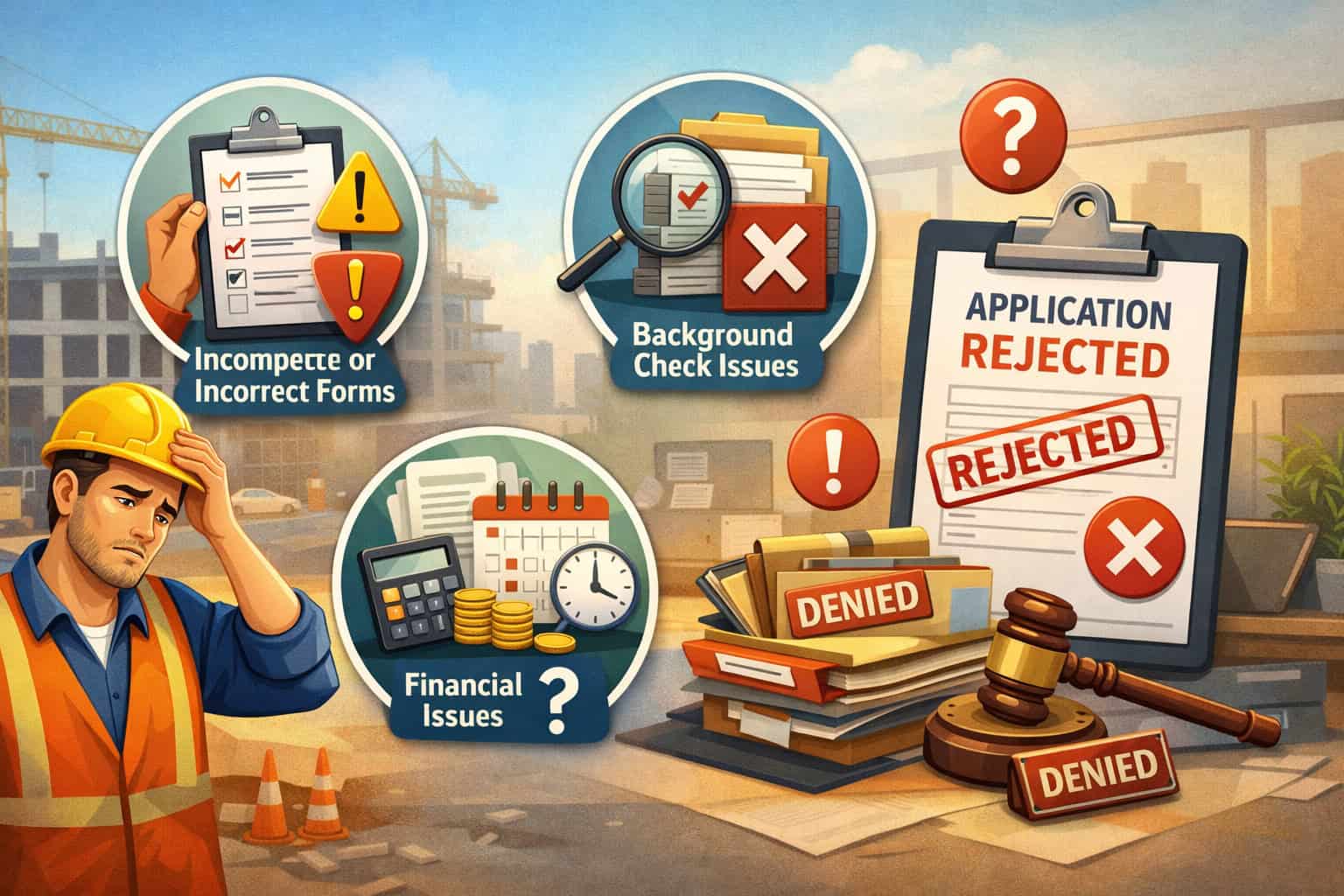
Contractor businesses often look straightforward—real work, real jobs, real customers. But from an underwriting perspective, the payment risk profile can be higher than many retail or professional service categories. Understanding why helps you address issues before you apply.
One common issue is large ticket / high average transaction size. A single job can be a big charge, which increases exposure if the customer disputes. Underwriters care less about your craftsmanship and more about what happens if a cardholder files a dispute after a scope change, a scheduling delay, or a misunderstanding over materials.
Another factor is deposits and progress payments. It’s normal in contracting to collect a deposit to secure labor and materials. But if a customer pays upfront and the project is delayed, the dispute window can still be open.
That timing mismatch is one reason contractors may be categorized as higher risk than businesses that deliver immediately.
Card-not-present vs card-present also matters. Many contractors accept payments remotely using invoicing and payment links.
CNP payments generally carry more fraud and dispute risk than a card-present transaction where the card is dipped/tapped/swiped at the customer’s location. If most payments are remote, underwriting will expect stronger controls (signed authorization, clear policies, AVS/CVV, and good documentation).
Finally, construction work is prone to scope changes. A homeowner may approve a change order verbally but dispute the final invoice later. Underwriting looks for consistent processes: written contracts, documented change orders, and proof of fulfillment / signed contracts.
Pro Tip: Underwriters aren’t judging your integrity—they’re verifying that your paperwork and policies match how you actually bill, collect deposits, and close out jobs. If you can show consistency, you speed up approval.
How underwriting for merchant accounts works

Underwriting is the review process that decides whether a payment provider can extend processing access to your business—and on what terms (limits, pricing, reserves, and funding timelines). Think of it as a risk and identity verification checkpoint, not a personal background check.
Underwriters generally evaluate three buckets:
- Who you are (identity + legitimacy): They verify business formation documents, ownership, EIN verification (if applicable), address consistency, and whether your business exists where you say it does. If your legal name differs from your marketing name, that’s fine—if it’s documented and consistent across the application.
- What you sell (business model + customer experience): They assess what services you perform, how customers book you, your cancellation and refund posture, and whether your advertising aligns with what you deliver. This is where website requirements for merchant approval can come into play—even a simple site can help show your services, contact methods, service area, and policies.
- How money will move (processing behavior + risk): They evaluate your expected monthly volume, average ticket, maximum ticket, seasonality, deposit schedule, and payment channels (card-present vs card-not-present). If you’re switching providers, your processing history (if switching providers) is one of the strongest pieces of evidence you can provide.
The point is consistency. A contractor who estimates a $300 average ticket but plans to run $8,000 remodel invoices will trigger follow-up questions. A business that asks for next-day funding but has frequent refunds will raise concerns. Underwriting isn’t “looking for reasons to say no.” It’s looking for reasons it can safely say “yes” with appropriate guardrails.
Pro Tip: Underwriting is faster when your application reads like a complete story: who you are, what you do, how you charge, when you deliver, and how you handle disputes—supported by documents that match.
Contractor merchant account requirements: documents and why underwriters need them
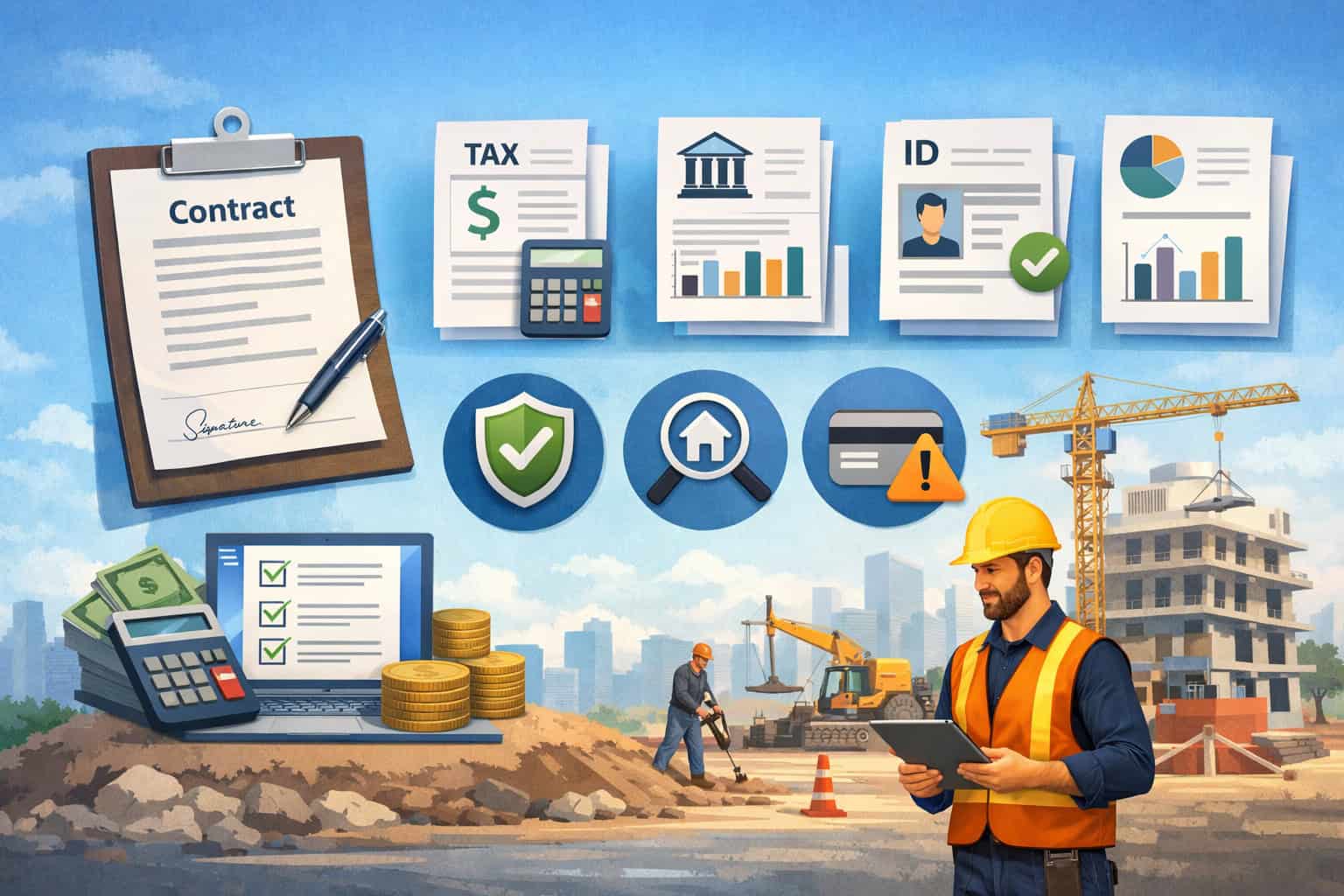
A smooth approval typically comes down to preparing the right documents in a clean format. If you provide a complete packet upfront, you reduce the “please send…” emails that stretch approval timelines.
Below is a requirements table you can use as your baseline. Your provider may request more or less depending on your risk profile, ticket size, and whether you’re card-present, card-not-present, or both.
Table 1: Contractor merchant account requirements (document checklist + why underwriters need it)
| Requirement / Document | What to submit (examples) | Why underwriting needs it |
|---|---|---|
| Business formation documents | Registration/formation record, operating agreement or equivalent (if available) | Confirms the legal entity and ownership structure |
| Ownership/identity verification | Owner ID, verification of controlling owner | Confirms the responsible party and reduces fraud risk |
| EIN verification (if applicable) | EIN confirmation letter or equivalent proof | Confirms tax identity and links entity to banking records |
| Business address consistency | Utility bill, lease excerpt, or business mailing proof | Confirms a stable operating address and reduces identity mismatches |
| Bank statements and financials | 3–6 recent months bank statements (business account) | Confirms cash flow, stability, and capacity for refunds/chargebacks |
| Voided check or bank letter | Voided check for settlement account | Ensures funds route correctly and prevents funding errors |
| Processing history (if switching providers) | 3–6 months processing statements | Shows real volume/ticket size and dispute/refund patterns |
| Sample contracts and invoices | Standard contract, invoice template, change order form | Proves how you bill, collect deposits, and document scope |
| Proof of fulfillment | Completion sign-off, photos, permits (if relevant), delivery docs | Shows you can demonstrate delivery if a dispute occurs |
| Customer-facing policies | Refund/cancellation/deposit terms (website or invoice) | Reduces dispute risk and proves transparent terms |
| Website requirements for merchant approval | Website URL or online presence screenshots | Confirms services, contact info, and policy visibility |
| Equipment/terminal requirements | POS/terminal model, mobile reader, virtual terminal use case | Aligns processing method with risk controls and fraud tools |
If you’re applying for a merchant account for a construction company that operates across multiple job types (repairs, remodels, new builds), be ready to provide a short explanation of your typical project mix and payment flow. Underwriters like clarity: “We take 30% deposit, 40% mid-project, 30% on completion,” supported by contract language.
Pro Tip: Save everything as clearly named PDFs (e.g., “BankStatement_Jan,” “SampleContract,” “ChangeOrderTemplate”). Underwriters review many files—clarity speeds approvals.
The complete merchant account approval checklist for contractors (step-by-step)
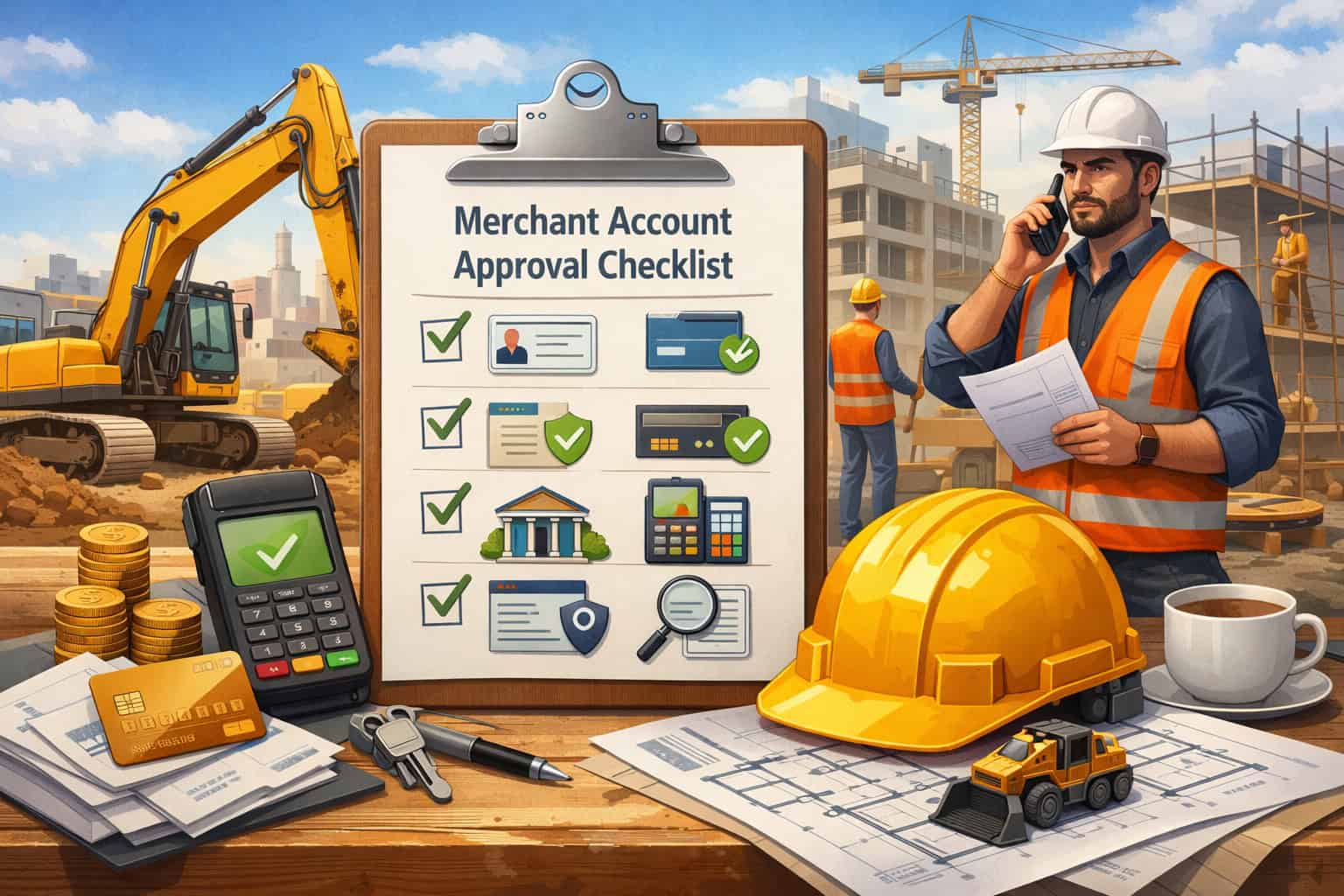
This is the heart of the merchant account approval checklist for contractors—the items that most often determine whether underwriting can approve quickly, request more information, or place limitations like lower initial caps or reserves.
Treat this as a step-by-step build of an “approval packet” you can reuse anytime you switch providers or add a new payment channel.
Business identity checklist: formation, EIN, and consistency
Your business identity is the foundation of the file. Underwriting will compare names, addresses, and ownership across your application, bank records, and public references. Inconsistencies are one of the biggest causes of avoidable delays.
Make sure you can provide:
- Legal business name exactly as registered
- Doing-business-as name (if different) and proof of it
- Business address and mailing address (with matching supporting documents)
- Owner/controlling party info that matches ID documents
- EIN verification (if applicable) or other tax ID proof
- A dedicated business bank account (recommended for clarity)
If you operate from a home office or shared workspace, that’s not automatically a problem. It becomes a problem when your application lists one address, your bank statements show another, and your invoice template shows a third.
Pro Tip: If you recently moved, include a short note in your packet: “Business address updated on X date; bank statements still reflect prior address due to statement cycle.” Underwriters appreciate proactive explanations.
Bank and financials checklist: statements, settlement account, and refund capacity
Underwriting is assessing whether your business can handle normal payment events: refunds, chargebacks, or short-term cash flow gaps. Contractors with large tickets and deposits look stronger when they can show stable banking and clean financial behavior.
Include:
- 3–6 months of recent business bank statements
- A voided check (or bank letter) for your settlement account
- Basic P&L snapshot if available (helpful for larger volumes)
- Notes on seasonality (busy months vs slow months)
Avoid submitting statements that are incomplete (missing pages), heavily altered, or inconsistent with your stated revenue and volume. Underwriting doesn’t expect perfection—it expects plausibility.
If your business is new, your bank history may be thin. That’s okay, but you’ll want to compensate with clearer policies, lower initial volume estimates, and strong job documentation.
Pro Tip: If you’re new and don’t have statements, be ready to start with conservative limits and build up after a few clean months of processing.
Processing profile checklist: average ticket, max ticket, monthly volume, seasonality
This is where many contractor applications accidentally create risk. Underwriters need accurate expectations so they can set controls that prevent sudden spikes.
Prepare these numbers:
- Average ticket: typical invoice amount (not your smallest job)
- Maximum ticket: your realistic “largest likely job”
- Monthly volume: what you expect to process per month
- Seasonality: when volume rises or falls
- Channels: percent card-present vs card-not-present
- Deposit schedule: how much upfront and when subsequent payments occur
If you expect large invoices, say so—and explain how you manage disputes (signed contracts, change orders, completion sign-offs). If you plan to process a big job right away, note it upfront instead of surprising the system with a sudden high-dollar charge.
Pro Tip: A realistic max ticket is better than a low number that triggers a “limit exceeded” decline on your first large project.
Service documentation checklist: contract, invoice, and change order process
Contractors win disputes with documentation. Underwriting loves documentation because it lowers chargeback risk reduction concerns.
Add these to your packet:
- Standard service agreement / contract template
- Itemized invoice template showing materials/labor and milestones
- Change order template with customer acknowledgment
- Deposit authorization language (especially for CNP payments)
- Completion sign-off form
If you don’t have a formal contract, underwriting may still approve you—but it’s more likely you’ll face lower initial limits, reserves, or additional conditions. A simple written agreement is often enough, as long as it clearly states scope, timeline, and payment terms.
Pro Tip: Include a redacted sample (remove personal customer details) showing how you present scope and payment stages.
Fulfillment proof checklist: signed completion, photos, and job artifacts
Contracting is not retail. Proof of fulfillment looks different—and that’s okay. Underwriters just need to see that you can demonstrate work was completed if a customer disputes.
Useful proof includes:
- Signed completion form (or final walkthrough sign-off)
- Before/after photos (stored by job)
- Timestamped progress updates (optional but helpful)
- Permits or inspection records (if relevant to your work)
- Delivery receipts for special-order materials (if applicable)
You’re not required to submit job photos in most cases, but showing that you have a standard process for keeping proof can help if you have higher ticket sizes.
Pro Tip: A simple line in your contract like “Customer agrees to sign completion confirmation at final walkthrough” can pay dividends in dispute prevention.
Customer-facing policies checklist: refunds, cancellations, deposits
Policies are a major underwriting focus because unclear terms cause disputes. You need policies that match contracting reality: deposits, material orders, scheduling, and cancellation windows.
At minimum, your refund and cancellation policy should:
- Explain what happens to deposits
- Explain how change orders affect pricing and timelines
- Define when a refund is available (and when it isn’t)
- Describe the cancellation process and fees (if any)
- Provide a customer contact method for billing issues
Policies don’t have to be harsh. They have to be clear. If your policies are vague (“All sales final”), underwriting may see elevated dispute risk.
Pro Tip: Put your policies on your website and on invoices. Underwriters like to see that customers can find terms before paying.
Online presence checklist: what must be displayed
In 2026, many providers expect some online footprint—even for local contractors who work by referral. You don’t need a fancy site, but you do need clarity.
Common website requirements for merchant approval include:
- Business name and contact info
- Service descriptions (what you do)
- Service area (city/region)
- Refund, cancellation, and deposit terms
- Privacy statement (basic)
- Clear descriptors that match your processing descriptor
If you don’t have a website, some providers will accept a business profile page or a simple one-page site. What matters is that your customer-facing information matches your application and shows legitimate operations.
Pro Tip: Use the same business name and phone number everywhere: invoices, website, and bank records. Consistency reduces delays.
Build your “approval packet”: a comprehensive checklist you can submit in one shot
A contractor approval packet is a single folder of documents that makes underwriting easier. Instead of sending documents one-by-one, you submit a complete file that answers common questions upfront.
Here’s a comprehensive packet checklist you can copy and use:
Approval packet checklist (recommended order)
- Business identity
- Formation/registration record
- DBA documentation (if applicable)
- Ownership verification + owner ID
- EIN verification (if applicable)
- Proof of business address (if needed)
- Banking
- Voided check or bank letter for settlement account
- 3–6 months bank statements and financials
- Brief note on seasonality or new-business context (if relevant)
- Processing profile
- Expected monthly volume
- Average ticket and maximum ticket
- Percent CNP vs card-present
- Deposit and progress payment schedule
- List of top services and price ranges
- Service documentation
- Sample contract (redacted)
- Invoice template (redacted)
- Change order template (redacted)
- Completion sign-off template
- Policies
- Refund policy
- Cancellation policy
- Deposits/progress payment terms
- Customer support contact method for billing issues
- Online presence
- Website link (preferred)
- Or screenshots of business page showing contact + services + policies
- History (if switching providers)
- 3–6 months processing statements
- Notes on any past chargebacks and what changed since
Pro Tip: Add a one-page “Processing Summary” at the front: what you do, typical ticket size, how you collect deposits, and how you prove completion. Underwriters love concise context.
Sample policy snippets you can paste into your website or invoices (text-only)
You want policies that are clear, fair, and aligned with how contractors operate. Below are sample snippets you can adapt. Keep them consistent across your website, invoices, and contracts.
Refund policy snippet (contractor-friendly)
Refund Policy
Payments are applied to labor performed and materials purchased for your project. If a refund is approved, it will be issued to the original payment method after we confirm any non-refundable material costs and completed work to date.
Refund requests must be submitted in writing within [X] days of the invoice date. We do not refund special-order materials once ordered, and we do not refund work that has been completed and approved at walkthrough or sign-off.
Pro Tip: Replace placeholders like [X] days with your real timeline, and align it with your contract language.
Cancellation policy snippet (clear and practical)
Cancellation Policy
To cancel or reschedule, customers must notify us at [phone/email] at least [X] business days before the scheduled start date. Cancellations after this window may incur a fee to cover scheduling, administrative time, and committed labor.
If materials have been ordered, the customer is responsible for any restocking fees or non-refundable supplier costs.
Pro Tip: Underwriters prefer a policy that explains why fees exist (labor scheduling and materials), not just the fee itself.
Deposits and progress payment terms snippet (milestones + transparency)
Deposits & Progress Payments
Projects may require a deposit before work begins to reserve scheduling and secure materials. Deposits are applied to the total project cost and are not a separate fee.
Progress payments may be due at defined milestones (for example: deposit, mid-project, and completion). Final payment is due upon substantial completion and final walkthrough. Any scope changes require a written change order that may adjust the project price and timeline.
Pro Tip: If you accept card-not-present payments, add a line that customers authorize remote billing based on invoice approval.
Red flags that slow contractor approvals and how to fix them
Many delays come down to small mismatches that are easy to correct. Underwriting teams move faster when they don’t have to reconcile contradictions.
Table 2: Red flags that delay approval + how to fix them
| Red flag | Why it delays approval | How to fix it (fast) |
|---|---|---|
| Business name mismatch across documents | Underwriters can’t verify identity | Align legal name/DBA on app, bank account, invoices, and website |
| Address mismatch (application vs bank statements) | Triggers verification requests | Update records or add a short explanation + proof of move |
| No written contract or vague scope | Increases dispute likelihood | Provide a simple service agreement + change order template |
| Vague refund/cancellation policy | Customers dispute unclear terms | Publish clear policies on website/invoices |
| Unrealistic volume estimates | Triggers risk review | Use conservative, realistic average/max ticket and monthly volume |
| First transaction is very large | Looks like a spike or laundering | Ask for limits that match your real needs; ramp volume gradually |
| High card-not-present percentage without controls | Higher fraud/dispute risk | Use signed authorization, AVS/CVV, clear descriptors, invoices |
| Website missing contact/policies | Legitimacy and transparency concerns | Add service descriptions, contact info, and policy page |
| Incomplete bank statements | Underwriter can’t assess cash flow | Provide full PDFs with all pages and matching names |
| Prior processing issues undisclosed | Surprises cause declines | Share processing history and what you changed (policies, controls) |
Pro Tip: If you can fix one thing today, fix consistency: business name, address, and contact info should match everywhere.
Risk profile factors: ticket size, deposits, and CNP volume—and how to mitigate them
Contractors can land anywhere on the “high-risk vs low-risk merchant accounts” spectrum depending on job size, payment method, and documentation habits. Construction itself isn’t automatically “high risk,” but certain patterns push risk higher.
Underwriting cares most about exposure (how much money could be disputed) and recoverability (how well you can prove the job and resolve issues). Large tickets and deposits raise exposure. High CNP volume and unclear policies reduce recoverability.
Table 3: Risk profile factors + mitigation steps (contractor-specific)
| Risk factor | Why it matters in underwriting | Mitigation steps that help approval |
|---|---|---|
| Large ticket / high average transaction size | Bigger disputes and higher loss severity | Stage payments; set realistic max ticket; keep signed scope and sign-off |
| Deposits before completion | Dispute window may stay open during delays | Document deposit purpose; milestone invoices; written cancellation terms |
| High card-not-present volume | Higher fraud/dispute rates | AVS/CVV; signed authorization; invoice approval trail; 3DS where applicable |
| Frequent change orders | Scope disputes are common | Written change orders; customer acknowledgment; updated invoices |
| Long project timelines | Disputes can occur mid-project | Progress documentation; milestone billing; communication logs |
| Limited processing history | Harder to predict behavior | Start with conservative volume; provide strong documentation and policies |
| High refund rate | Can indicate customer dissatisfaction | Clear expectations; better invoicing detail; proactive issue resolution |
| New business with thin financials | Less evidence of stability | Provide bank statements available; lower initial limits; show booked work |
Pro Tip: If your tickets are large, don’t fight it—own it. Explain your milestone billing, provide a sample contract, and show proof-of-fulfillment practices.
Risk profile factors: ticket size, deposits, and CNP volume—and how to mitigate them
Contractors can land anywhere on the “high-risk vs low-risk merchant accounts” spectrum depending on job size, payment method, and documentation habits. Construction itself isn’t automatically “high risk,” but certain patterns push risk higher.
Underwriting cares most about exposure (how much money could be disputed) and recoverability (how well you can prove the job and resolve issues). Large tickets and deposits raise exposure. High CNP volume and unclear policies reduce recoverability.
Table 3: Risk profile factors + mitigation steps (contractor-specific)
| Risk factor | Why it matters in underwriting | Mitigation steps that help approval |
|---|---|---|
| Large ticket / high average transaction size | Bigger disputes and higher loss severity | Stage payments; set realistic max ticket; keep signed scope and sign-off |
| Deposits before completion | Dispute window may stay open during delays | Document deposit purpose; milestone invoices; written cancellation terms |
| High card-not-present volume | Higher fraud/dispute rates | AVS/CVV; signed authorization; invoice approval trail; 3DS where applicable |
| Frequent change orders | Scope disputes are common | Written change orders; customer acknowledgment; updated invoices |
| Long project timelines | Disputes can occur mid-project | Progress documentation; milestone billing; communication logs |
| Limited processing history | Harder to predict behavior | Start with conservative volume; provide strong documentation and policies |
| High refund rate | Can indicate customer dissatisfaction | Clear expectations; better invoicing detail; proactive issue resolution |
| New business with thin financials | Less evidence of stability | Provide bank statements available; lower initial limits; show booked work |
Pro Tip: If your tickets are large, don’t fight it—own it. Explain your milestone billing, provide a sample contract, and show proof-of-fulfillment practices.
How to get approved for a merchant account as a contractor: practical strategies that work
If you want to get approved for a merchant account as a contractor, focus on reducing uncertainty. Underwriters move faster when they can clearly see your business model, your pricing behavior, and your dispute-prevention practices.
Set realistic limits and ramp responsibly
Approval is often easier when you ask for limits that match your current reality. If you’re new, pushing for high maximum tickets and high monthly volume can trigger extra review—or lead to restrictions you weren’t expecting.
Instead:
- Start with reasonable monthly volume based on booked work
- Use a realistic max ticket that covers typical jobs
- Plan a gradual increase after 60–90 days of clean processing
This isn’t about “playing small.” It’s about giving underwriting a credible starting point and building trust through performance.
Pro Tip: If you have a big job coming up, disclose it upfront with a contract sample and milestone schedule. Surprises are what cause freezes.
Explain your deposit schedule like a risk manager
Deposits are normal in construction, but underwriting wants to know: “What if the job doesn’t start on time?” You can reduce concerns by describing:
- Deposit percentage and what it covers (scheduling, labor allocation, materials)
- Milestone billing approach
- Cancellation and refund terms for deposits and materials
- How you document customer approval
A simple “Deposit & Milestones” page (or contract section) can make you look significantly lower risk.
Pro Tip: Milestone-based invoicing is both good business and good underwriting hygiene.
Strengthen your paper trail (it’s your dispute shield)
In a construction business merchant account approval guide, documentation isn’t optional—it’s your best risk tool.
Use:
- Written contracts with scope and timeline
- Written change orders
- Itemized invoices with milestone labels
- Completion sign-off or final walkthrough acknowledgment
- Photos or progress documentation stored by job
Underwriting often approves faster when they see you can defend your transactions.
Pro Tip: Your goal is to make it easy to answer “What did the customer agree to?” and “What proof exists?”
Risk controls that help approval and reduce disputes (contractor-specific)
Contractors have unique workflows: estimates, scheduling, materials procurement, site access issues, and change orders. The right controls make underwriting more comfortable and protect your revenue.
Staged payments and milestone billing
Staged payments reduce exposure. Instead of one large charge, you collect:
- Deposit (scheduling/materials)
- Mid-project payment tied to a milestone
- Final payment on completion
This aligns payments with progress, lowering the chance of a large dispute and reducing reserve pressure.
Pro Tip: Put milestone names on invoices (e.g., “Milestone 2—Rough-In Complete”) so billing matches job progress.
Signed authorization for card-not-present (CNP) payments
For invoicing and payment links, get authorization in writing. This can be:
- A clause in the contract allowing remote billing
- An invoice acceptance statement
- A separate payment authorization form
Also consider tools like AVS/CVV and fraud filters in your gateway or virtual terminal.
Pro Tip: For phone payments, avoid manually keying cards without clear authorization and identity checks. Keep records of who authorized and when.
Use AVS/CVV, 3DS (where applicable), and fraud tools
High-level best practices that often help underwriting:
- AVS (Address Verification Service): checks billing address match
- CVV: confirms security code presence
- 3DS (where applicable): adds issuer authentication for certain online transactions
- Velocity controls: limit repeated attempts and suspicious patterns
- Customer verification: confirm name, phone, and email consistency
These tools don’t eliminate disputes, but they reduce fraud exposure—especially in CNP environments.
Pro Tip: Ask your provider which fraud tools are available for invoicing and payment links and turn on the basics from day one.
Descriptors and invoice clarity
A major cause of chargebacks is “I don’t recognize this charge.” Your billing descriptor should match your business name and be familiar to customers.
Also:
- Include job address or project name on invoices
- Use customer-friendly invoice numbering
- Add a support phone/email on every invoice
Pro Tip: If your descriptor differs from your marketing name, disclose it in the invoice: “Charges will appear as: [Descriptor].”
Reduce chargebacks: contractor-specific chargeback risk reduction playbook
Chargebacks in construction are often about communication and documentation, not fraud. The goal is to prevent disputes before they happen and to win them when they do.
Prevent “services not as described” disputes with scope discipline
Most contractor disputes start with expectations. Use these habits:
- Provide written scope and exclusions
- Use line-item estimates (labor, materials, allowances)
- Confirm start dates and access requirements
- Send change orders immediately when scope changes
When you treat scope changes as normal—but always documented—you reduce the emotional “surprise invoice” moments that lead to chargebacks.
Pro Tip: If a customer requests a change verbally, send a written summary the same day and ask for confirmation.
Tie invoices to milestones and proof of completion
When your invoice clearly maps to progress, disputes are harder to justify.
- Label invoices by milestone
- Attach photos or a brief progress note where appropriate
- Collect completion sign-off at final walkthrough
- Keep communication logs (texts/emails) in a job folder
Underwriters like this because it shows your model reduces disputes.
Pro Tip: A signed completion form is one of the strongest dispute defenses a contractor can have.
Respond to billing questions fast—before they become disputes
Many customers filed chargebacks because they couldn’t reach the contractor. Make it easy:
- Put a billing support email/phone on invoices
- Reply within one business day
- Offer a clear path: “We’ll review your concern and respond within [X] days”
Chargeback prevention is often customer service plus documentation. That combination reduces both disputes and reserve pressure.
Pro Tip: Even if you disagree, acknowledge the concern and document your response. Silence turns into disputes.
Reserves and rolling reserve: what contractors should expect
If your business processes large tickets, takes deposits, or has high card-not-present volume, you may be placed on reserve—especially early on. A reserve is not automatically a punishment. It’s a risk management tool that protects the processor and bank if disputes occur.
What reserves are (in contractor terms)
A reserve is money held back temporarily from your settlements to cover potential chargebacks and refunds. Common scenarios that lead to reserves:
- New business with limited processing history
- Large average tickets or high maximum tickets
- Deposit-heavy billing models
- Higher CNP percentage
- Previous processing issues or elevated refund rates
Common reserve types (including rolling reserve)
- Rolling reserve: a percentage of each batch is held for a set period (e.g., 90–180 days) and released on a rolling basis
- Upfront reserve: a fixed amount held early on (less common for smaller contractors)
- Triggered reserve: applied if volume spikes or disputes rise
Underwriters choose reserve structure based on expected exposure. If your jobs are large, they may want a cushion until you demonstrate stable, low-dispute processing.
Pro Tip: Reserves can be negotiable over time. The best leverage is clean performance.
How to reduce reserves over time
You generally reduce reserve requirements by showing:
- Low chargebacks and low refunds
- Stable volume without sudden spikes
- Strong documentation practices
- Clear policies and fewer customer complaints
- A few months of consistent processing history
If you were placed on reserve, ask your provider what performance metrics could lead to a reduction review. Keep your paper trail strong and disputes low, and you’re more likely to improve terms.
Pro Tip: Avoid sudden volume jumps while on reserve. If a big job is coming, notify your provider in advance with documentation.
Funding timelines: what to expect after approval
Approval doesn’t always mean immediate, same-day access to funds. Funding timelines depend on your provider, your settlement schedule, and your risk profile.
Typical funding factors include:
- Batch time (when you close your day)
- Business day vs weekend/holiday timing
- New-account monitoring windows
- Transaction review for unusually large tickets
- Reserve settings if applicable
If you plan to use deposits for materials, ask your provider about realistic funding timelines and whether large first transactions may trigger review.
Pro Tip: For large-ticket jobs, consider collecting deposits by card and later milestones by bank transfer or other methods if it fits your customer base—while keeping your merchant profile consistent and compliant.
Common mistakes to avoid (the fastest way to slow approval)
Mistakes are usually not “fraud”—they’re incomplete applications and mismatched expectations. Here are the ones that matter most.
Mismatched business name/address across documents
If your bank statement shows a different name than your application, underwriting will stop and ask questions. Fix it with consistency or add documentation explaining the difference.
Vague refund policy or missing cancellation language
Contractors deal with scheduling and materials. If your policies don’t explain deposits and cancellations, customers may dispute even reasonable charges.
No written contract or change order process
You don’t need a 20-page contract. You do need something written. Underwriting wants to see you can prove agreements.
Unrealistic volume estimates
If you’re applying for a merchant account for a construction company and you guess too high, you look risky. If you guess too low, you’ll exceed limits quickly. Use real estimates based on booked work and typical projects.
Trying to process a huge first transaction without history
Even approved accounts can trigger review if the first transaction is far above your profile. If you have a large project coming, disclose it upfront and provide documentation.
Pro Tip: A “clean first month” is powerful. Start steady, document everything, and scale responsibly.
MCC code for contractors (high-level) and why it matters
An MCC code (Merchant Category Code) is a classification used by card networks and banks to categorize businesses. It influences risk models, interchange behavior, and underwriting expectations. Contractors may fall into categories associated with home services, construction trades, or specialized contracting—depending on your services.
The key point: your classification should match what you actually do. If you’re a general contractor but your materials sales dominate, or you run a heavy invoicing model with large CNP volume, your risk profile might look different than a small repair-focused contractor.
You generally won’t “choose” an MCC like picking a menu item, but you can help by describing your services accurately and keeping your marketing consistent with your application.
Pro Tip: Be specific about your services and billing model. The more your profile matches your real operations, the fewer underwriting surprises you’ll face.
Equipment and payment method planning: terminals, mobile readers, invoices, and links
Your payment setup affects risk. Underwriters want to know how you’ll accept payments and whether your tools fit your workflow.
Card-present setups (on-site)
If you take payments at the job site:
- Use tap/dip (EMV) whenever possible
- Prefer devices with receipt options
- Capture customer signature for large amounts if supported
Card-present generally reduces fraud exposure, but disputes can still happen if scope is unclear.
Card-not-present setups (remote invoices and links)
If you bill remotely, ensure you have:
- Invoice records and customer contact details
- Signed authorization language in contract or invoice flow
- AVS/CVV enabled where supported
- Clear descriptors and policy visibility
Invoicing and payment links can be a strong contractor workflow—when paired with documentation.
Pro Tip: If most of your payments are CNP, be proactive about authorization and proof-of-fulfillment. That combination improves approval odds.
Approval timeline checklist: Day 0–7 preparation and what to expect
Approval timelines vary, but most contractor approvals follow a similar rhythm—especially if you submit a full packet.
Table 4: Approval timeline checklist (Day 0–7)
| Day | What you should do | What underwriting may do | What to watch for |
|---|---|---|---|
| Day 0 | Assemble approval packet; verify names/addresses | Initial review begins | Missing pages, mismatched names, unclear volume |
| Day 1 | Submit processing summary + documents together | Identity + banking verification | Requests for EIN verification or address proof |
| Day 2 | Provide contract/invoice/change order samples | Business model and risk review | Questions about deposits, timelines, CNP volume |
| Day 3 | Confirm website/policies are live and consistent | Policy review + online presence check | Missing refund/cancellation terms |
| Day 4 | Clarify any large-ticket needs and limits | Limit setting and potential reserve decisions | Large first transaction concerns |
| Day 5 | Respond quickly to follow-up questions | Final approval steps | Delays due to slow responses |
| Day 6–7 | Test a small first transaction | Monitoring and funding setup | Don’t spike volume immediately |
Pro Tip: Speed comes from responsiveness. If underwriting asks a question, answer the same day with documents, not guesses.
FAQs
Q1) What documents do contractors need for merchant account approval?
Answer: Most contractors should be ready with business formation documents, ownership/identity verification, bank statements, a voided check, and service documentation like a sample contract, invoice template, and change order form.
Clear refund/cancellation/deposit policies and an online presence that matches the application often help.
Q2) How long does it take to get approved?
Answer: It depends on your provider and the completeness of your packet. Submitting a full, consistent approval packet can reduce back-and-forth. If underwriting needs clarifications (ticket size, deposits, CNP volume), timelines can extend.
Q3) Why would a contractor be considered “higher risk”?
Answer: Common reasons include large ticket sizes, deposit-heavy billing before completion, higher dispute risk when scope changes, and high card-not-present invoicing volume. These factors increase exposure if a customer disputes.
Q4) What is a rolling reserve and why is it required?
Answer: A rolling reserve is when a percentage of settlements is held for a set period and released over time. It’s used to cover potential chargebacks/refunds, especially for newer businesses, higher tickets, or deposit-heavy models.
Q5) Can contractors accept deposits by credit card?
Answer: Often yes, but approval depends on your deposit policy, documentation, and risk profile. Underwriting typically wants clear deposit terms, milestone billing, and proof-of-fulfillment practices.
Q6) How can I lower chargebacks for construction payments?
Answer: Use written contracts, documented change orders, milestone invoices, signed completion forms, and clear policies. Add fast customer communication and keep proof of work (photos, logs) to reduce disputes and improve representation outcomes.
Q7) What’s the difference between a merchant account and a payment aggregator?
Answer: A merchant account is typically underwritten and set up for your business with defined limits and terms. A payment aggregator groups many businesses under one master account and may have different risk controls and stability characteristics. Your best fit depends on ticket size, volume, and business model.
Q8) Can I process large-ticket payments?
Answer: Yes, but you should disclose realistic maximum ticket needs during onboarding. Underwriting may require stronger documentation, milestone billing, or reserves depending on the risk profile.
Q9) Do I need a website to get approved?
Answer: Not always, but a simple website (or strong online presence) that shows services, contact info, service area, and policies often helps underwriting verify legitimacy and transparency.
Q10) What is PCI compliance and do contractors need it?
Answer: PCI compliance basics apply to any business that accepts card payments. Your provider typically offers tools and guidance. Following PCI practices helps reduce risk and protect customer data.
Q11) Why did my application ask about average and maximum ticket?
Answer: These numbers help underwriting set safe limits and detect unusual spikes. For contractors, large tickets are normal—what matters is that your estimates match your real billing pattern.
Q12) What should I do if I’m switching providers?
Answer: Provide processing history statements, explain your typical job tickets and volume, and disclose any past disputes and what you changed. A clean history can speed approval.
Q13) Can I take payments by invoice and payment link safely?
Answer: Yes, especially when paired with signed authorization language, AVS/CVV where supported, clear descriptors, and strong documentation (contracts, change orders, completion proof).
Q14) What happens if my first transaction is bigger than expected?
Answer: It may be reviewed or declined if it exceeds your approved profile. If you have a large job coming, disclose it upfront and ask for a max ticket that matches your real need.
Q15) What if underwriting asks for more documents?
Answer: Respond quickly and provide complete PDFs. If there’s a mismatch (recent address change, new bank account), include a short written explanation with supporting proof.
Conclusion
Contractor approvals don’t have to be stressful. In most cases, delays come from mismatched details, missing policies, or unclear payment profiles—not from the fact that you’re a contractor.
When you submit a complete approval packet, use realistic ticket and volume estimates, and show solid documentation for scope, deposits, and completion, underwriting can evaluate your file faster and set terms that support stable growth.
Use this 2026 construction business merchant account approval guide as your practical playbook: reduce ambiguity, strengthen your paper trail, and treat your payment setup like part of your customer experience.
Your customers get clearer expectations, you get fewer disputes, and your merchant account relationship stays healthier over time.